
TRAVEL MEDICINE · IMMUNITY
How to Check Your Vaccine Immunity Status
Preparing to travel internationally and not sure if your childhood vaccinations still protect you? Here's exactly what to check — and whether a titer test for travel is the right next step.


This page will help you check your vaccination status and answer three practical questions:
1. I have my immunization records — what do I look for, and am I covered?
2. I don't have records — how do I find them, and what if I can't?
3. I was vaccinated a long time ago — could my immunity have worn off?
WORTH KNOWING UPFRONT
For most routine vaccines, receiving an extra dose is safe even if you've already had the series. So if tracking down records or getting a blood test adds more complexity than it's worth, re-vaccination is always a valid option.
01
If you have your records
What to look for on your immunization record
Check your record against the following. If your doses and dates match, you are generally considered protected:


When a record alone may not be enough
There are situations where having a record doesn't fully answer the question:
• You only received one dose of a two-dose vaccine and the series was never completed
• Your record shows the vaccine but the dates are incomplete or unclear
• You received MMR as a child and have specific concern about mumps immunity
• You received the varicella vaccine more than 20 years ago and want to confirm your status
• Your employer, school, or destination country specifically requires a blood test rather than a record
In these cases, an antibody titer test provides definitive confirmation — see the section below on what that test involves.
02
If you don't have records
How to find lost immunization records — and what to do if you can't
There is no single national database for vaccination records in the United States. But there are several places worth checking before assuming the records are gone for good.
WHERE TO LOOK FIRST
Your childhood pediatrician's office
• Your state's Immunization Information System (IIS) — most states maintain a centralized registry; contact your state health department or visit their website to request records
• MyIR Mobile (myirmobile.com) — available in select states; lets you view and print official immunization records
• Your school or college — K–12 schools and universities often keep vaccine records on file for enrolled students
• Previous employers — particularly if you've worked in healthcare or the military
• Baby books and family documents — paper records are sometimes found in childhood keepsakes
• MyChart or your current patient portal — if you've been a patient anywhere, records may have transferred electronically
IF RECORDS TRULY CANNOT BE FOUND
When records are unavailable, you have two options:
Get an antibody titer test
A blood test that checks whether you developed immunity, regardless of whether you can prove you were vaccinated.
Re-vaccinate
In many cases, this is simpler and less expensive than testing.
If you need proof of immunity without vaccination records, we can help you decide which approach is right for your situation and travel timeline.
03
Getting a titer test
• A standard blood draw — no fasting or special preparation required
• Results are typically returned within 24–72 hours
If you recently received a vaccine and want to confirm it worked, wait at least 6–8 weeks after completing the series or after a booster before testing. Testing too soon may return an inaccurate result.
04
How long does vaccine immunity last?
The table below covers vaccines commonly reviewed in a travel medicine setting. Use it to get a general sense of where you stand.


If your records show vaccines from many years ago and you're uncertain whether protection has held, a titer test is the most direct way to get an answer.
05
How to read a titer test result
POSITIVE
Your immunity is confirmed. You have enough protection against that disease for travel, school, or employment purposes.
NEGATIVE
Protection is not detected. What to do next depends on your vaccine history:
• No documented history: you'll need the full vaccine series (2 or 3 doses)
• Documented prior series: a single booster shot is typically sufficient
EQUIVOCAL
The result falls in a borderline range. A booster is generally recommended.
Sample lab reports
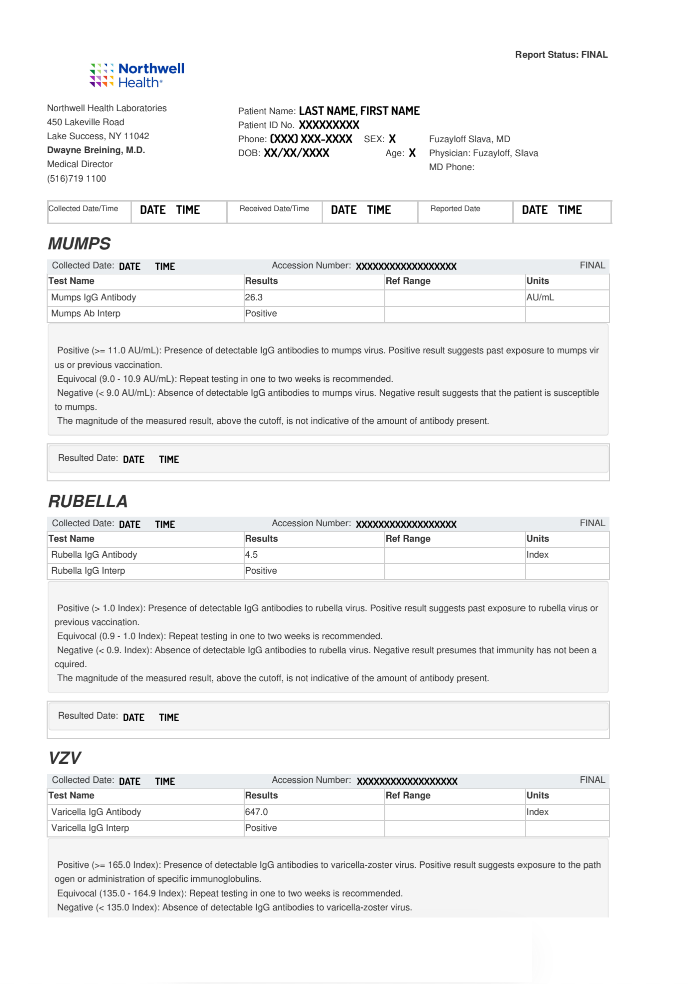
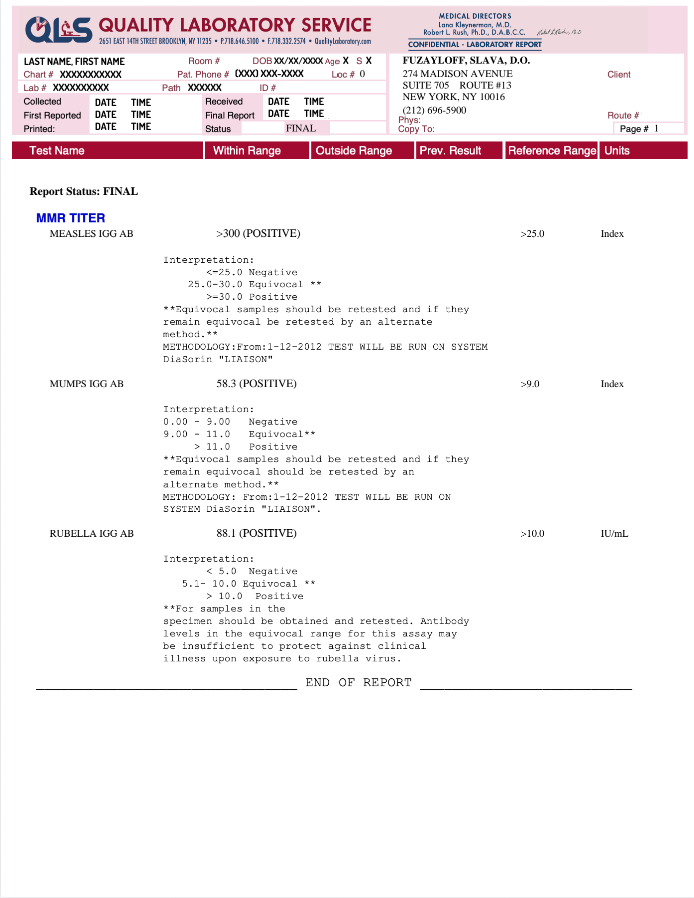
Below are two examples of how titer results appear from different laboratory systems. The most commonly ordered tests are the MMR titer test and the varicella titer.
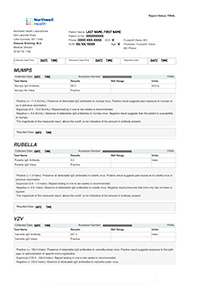
Northwell — MMR example
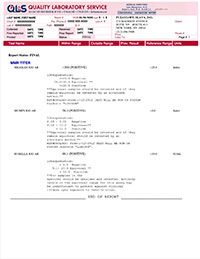
Quest — MMR example
When submitting results to a school or employer, what matters is whether your result falls above or below the reference range printed on your report.
06
Do I need a booster?
What happens next
No immunity detected
You'll need to complete the full initial vaccine series — 2 or 3 doses over a set period. If your travel date is approaching, discuss timing with your provider early; some series take several months.
Low but not zero immunity
One booster dose is sufficient. There is no need to restart the full series. Allow at least 6–8 weeks after the booster before retesting to confirm your levels have risen.
What if I don't respond to vaccination?
A small number of people — roughly 2–10%, depending on the vaccine — don't develop adequate immunity even after the full series. If your titer remains low after a second complete series, your provider can document this and advise on what it means for your travel or work.
07
Who else should get a titer test
The sections above focus on travelers. Healthcare workers, nursing students, and medical school applicants also commonly need titer testing — most hospitals and clinical programs require documented proof of immunity, and a vaccination record alone is usually not accepted. The standard panel includes:
• MMR (measles, mumps, rubella)
• Varicella
• Hepatitis B (hepatitis B surface antibody test)
• TB screening (QuantiFERON Gold)
• Polio (some institutions)
• Tetanus (some institutions)
• Rabies (animal / veterinary work)
• Hepatitis A (food industry workers)
Not sure where you stand? We can help.
We order titer tests regularly and can tell you exactly which ones apply to your situation and travel destination. Call us or schedule online.
35 W 36th Street, Suite 7E
New York, NY 10018
212.696.5900